Thursday, September 8, 2016

Fannie Mae and Freddie Mac

The Federal National Mortgage Association (FNMA), commonly known as Fannie Mae, is a government-sponsored enterprise (GSE) and, since 1968, a publicly traded company.

Founded in 1938 during the Great Depression as part of the New Deal,the corporation's purpose is to expand the secondary mortgage market by securitizing mortgages in the form of mortgage-backed securities (MBS),allowing lenders to reinvest their assets into more lending and in effect increasing the number of lenders in the mortgage market by reducing the reliance on locally based savings and loan associations (or "thrifts"). Its brother organization is the Federal Home Loan Mortgage Corporation (FHLMC), better known as Freddie Mac.

Fannie Mae headquarters at 3900 Wisconsin Avenue, NW in Washington, D.C.
Type
Government-sponsored enterprise and public company
Traded as OTCQB: FNMA
Industry Financial services
Founded 1938; 78 years ago
Headquarters Washington, D.C., U.S.
Key people
Tim Mayopoulos, CEO
Products Diversified investments
Revenue Decrease US$ 25.8 billion (2014)
Net income
Decrease US$ 14.2 billion (2014)
Total assets Decrease US$ 3.248 trillion (2014)
Total equity Decrease US$ 3.7 billion (2014)
Number of employees
7,200 (2013)
Website www.fanniemae.com


 The Great Depression wrought havoc on the U.S. housing market. By 1933, an estimated 20-25% of the nation's outstanding mortgage debt was in default. Fannie Mae was established in 1938 by amendments to the National Housing Actas part of Franklin Delano Roosevelt's New Deal.

Originally chartered as the National Mortgage Association of Washington, the organization's explicit purpose was to provide local banks with federal money to finance home mortgages in an attempt to raise levels of home ownership and the availability of affordable housing.

Fannie Mae created a liquid secondary mortgage market and thereby made it possible for banks and other loan originators to issue more housing loans, primarily by buying Federal Housing Administration (FHA) insured mortgages. For the first thirty years following its inception, Fannie Mae held a monopoly over the secondary mortgage market.

 Other considerations may have motivated the New Deal focus on the housing market: about a third of the nation's unemployed were in the building trade, and the government had a vested interest in getting them back to work by giving them homes to build.

Fannie Mae was acquired by the Housing and Home Finance Agency from the Federal Loan Agency as a constituent unit in 1950. In 1954, an amendment known as the Federal National Mortgage Association Charter Act made Fannie Mae into "mixed-ownership corporation" meaning that federal government held the preferred stock while private investors held the common stock; in 1968 it converted to a privately held corporation, to remove its activity and debt from the federal budget. In the 1968 change, arising from the Housing and Urban Development Act of 1968, Fannie Mae's predecessor (also called Fannie Mae) was split into the current Fannie Mae and the Government National Mortgage Association ("Ginnie Mae").

In 1970, the federal government authorized Fannie Mae to purchase conventional mortgages, the same year it went public on New York and Pacific Exchanges.

In 1981, Fannie Mae issued its first mortgage pass through and called it a mortgage-backed security. The Fannie Mae laws did not require the Banks to hand out subprime loans in any way.

Ginnie Mae had guaranteed the first mortgage pass through security of an approved lender in 1968 and in 1971 Freddie Mac issued its first mortgage pass through, called a participation certificate, composed primarily of private mortgages.

 In 1999, Fannie Mae came under pressure from the Clinton administration to expand mortgage loans to low and moderate income borrowers by increasing the ratios of their loan portfolios in distressed inner city areas.

Additionally, institutions in the primary mortgage market pressed Fannie Mae to ease credit requirements on the mortgages it was willing to purchase, enabling them to make loans to subprime borrowers at interest rates higher than conventional loans.

House Price Index - HPI

House Price Index (HPI) measures the price changes of residential housing. Methodologies commonly used to calculate HPI are the hedonic regression (HR), simple moving average (SMA) and repeat-sales regression (RSR).

The HPI was developed in conjunction with OFHEO's (now FHFA) responsibilities as a regulator of Fannie Mae and Freddie Mac. It is used to measure the adequacy of their capital against the value of their assets, which are primarily home mortgages.
In Canada, the New Housing Price Index is calculated monthly by Statistics Canada. Additionally, a resale house price index is also maintained by the Canadian Real Estate Association, based on reported sale prices submitted by real estate agents, and averaged by region. In December 2008, the private National Bank and the information technology firm Teranet began a separate monthly house price index based on resale prices of individual single-family houses in selected metropolitan areas, using a methodology similar to the Case-Shiller index and based on actual sale prices taken from government land registry databases. This allows Teranet and the National Bank to track prices without allowing periods of high sales in one city to push up the national average. The National Bank also operates a forward market on Canadian housing prices.

Hedonic Regression(HR)

 In economics, hedonic regression or hedonic demand theory is a revealed preference method of estimating demand or value. It decomposes the item being researched into its constituent characteristics, and obtains estimates of the contributory value of each characteristic. 
In real estate economics, hedonic pricing is used to adjust for the problems associated with researching a good that is as heterogeneous as buildings. Because buildings are so different, it is difficult to estimate the demand for buildings generically. Instead, it is assumed that a house can be decomposed into characteristics such as number of bedrooms, size of lot, or distance to the city center. 
A hedonic regression equation treats these attributes (or bundles of attributes) separately, and estimates prices (in the case of an additive model) or elasticity (in the case of a log model) for each of them. This information can be used to construct a price index that can be used to compare the price of housing in different cities, or to do time series analysis. 
As with CPI calculations, hedonic pricing can be used to correct for quality changes in constructing a housing price index. It can also be used to assess the value of a property, in the absence of specific market transaction data. It can also be used to analyze the demand for various housing characteristics, and housing demand in general. It has also been used to test assumptions in spatial economics. 

Hedonic models are commonly used in tax assessment, litigation, academic studies, and other mass appraisal projects

Simple Moving Average (SMA)

In statistics, a moving average (rolling average or running average) is a calculation to analyze data points by creating series of averages of different subsets of the full data set. It is also called a moving mean (MM) or rolling mean and is a type of finite impulse response filter. Variations include: simple, and cumulative, or weighted forms
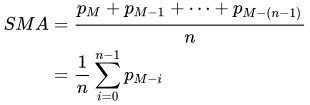
In financial applications a simple moving average (SMA) is the unweighted mean of the previous n data. However, in science and engineering the mean is normally taken from an equal number of data on either side of a central value.

If those prices are p_{M},p_{M-1},\dots ,p_{M-(n-1)} then the formula is
{\displaystyle {\begin{aligned}SMA&={\frac {p_{M}+p_{M-1}+\cdots +p_{M-(n-1)}}{n}}\\&={\frac {1}{n}}\sum _{i=0}^{n-1}p_{M-i}\end{aligned}}}
When calculating successive values, a new value comes into the sum and an old value drops out, meaning a full summation each time is unnecessary for this simple case,

{\displaystyle {\textit {SMA}}_{\mathrm {today} }={\textit {SMA}}_{\mathrm {yesterday} }+{p_{M} \over n}-{p_{M-n} \over n}}

 Repeat Sales Regression (RSR)


Perhaps the most well-known housing index that uses the repeat-sales method is the Case-Shiller Index, which measures changes in house prices. It excludes new construction, condos and co-ops. It also excludes non-arms-length transactions, such as home sales between family members at below-market prices. It does include foreclosure sales. 

Other indexes that use the repeat-sales method are the Federal Housing Finance Agency’s monthly House Price Index, which is based on Fannie Mae and Freddie Mac’s data on single-family home sale prices and refinance appraisals; and Core Logic’s Loan Performance 

Home Price Index, which covers a broader geographic area than the Case-Shiller or FHFA indexes. Canada’s major home price index, the National Composite House Price Index, uses the repeat-sales method, too. Indexes such as these typically report changes in home prices from the previous month, quarter and year. Increasing home prices indicate increasing demand, while decreasing prices indicate decreasing demand.

An advantage of repeat-sales methods is that they calculate changes in home prices based on sales of the same property, so they avoid the problem of trying to account for price differences in homes with varying characteristics. Repeat-sales methods also offer a more accurate alternative to regression analysis or to calculating average sales price by geographic area. A shortcoming of repeat-sales methods is that they don’t account for homes that were sold only once during the reported time period.

Office of Federal Housing Enterprise Oversight (OFHEO)

The Office of Federal Housing Enterprise Oversight (OFHEO) was an agency within the Department of Housing and Urban Development of the United States of America. It was charged with ensuring the capital adequacy and financial safety and soundness of two government sponsored enterprises—the Federal National Mortgage Association (Fannie Mae) and the Federal Home Loan Mortgage Corporation (Freddie Mac). It was established by the Federal Housing Enterprises Financial Safety and Soundness Act of 1992.

OFHEO was managed by a Director, appointed by the President and ratified by the Senate.

FHFA/OFHEO

The US Federal Housing Finance Agency (formerly Office of Federal Housing Enterprise Oversight a.k.a. OFHEO) publishes the HPI inx, a quarterly broad measure of the movement of single-family house prices.

Federal Housing Finance Agency (FHFA


The Federal Housing Finance Agency (FHFA) is an independent federal agency created as the successor regulatory agency resulting from the statutory merger of the Federal Housing Finance Board (FHFB), the Office of Federal Housing Enterprise Oversight (OFHEO), and the U.S. Department of Housing and Urban Development government-sponsored enterprise mission team, absorbing the powers and regulatory authority of both entities, with expanded legal and regulatory authority, including the ability to place government sponsored enterprises (GSEs) into receivership or conservatorship.

In its role as regulator, it regulates Fannie Mae, Freddie Mac, and the 11 Federal Home Loan Banks (FHLBanks, or FHLBank System). It is wholly separate from the Federal Housing Administration, which largely provides mortgage insurance.

Thursday, August 25, 2016

Check Your Credit Report

Everyone who's ever borrowed money to buy a car or a house or applied for a credit card or any other personal loan has a credit file.
Because we love to borrow money, that means almost every adult Canadian has a credit file. More than 21 million of us have credit reports. And most of us have no idea what's in them.

Are there mistakes? Have you been denied credit and don't know why? Is someone trying to steal your identity? A simple check of your credit report will probably answer all those questions. And it's free for the asking.

What's in a credit report?

 Each of the accounts includes a notation that includes a letter and a number. The letter "R" refers to a revolving debt, while the letter "I" stands for an instalment account. The numbers go from 0 (too new to rate) to 9 (bad debt or placed for collection or bankruptcy.) For a revolving account, an R1 rating is the notation to have. That means you pay your bills within 30 days, or "as agreed."

What is a credit score?

A credit rating or score (also called a Beacon or a FICO score) is not part of a regular credit report. Basically, it's a mathematical formula that translates the data in the credit report into a three-digit number that lenders use to make credit decisions. 

 The numbers go from 300 to 900. The higher the number, the better. For example, a number of 750 to 799 is shared by 27 per cent of the population. Statistics show that only two per cent of the borrowers in this category will default on a loan or go bankrupt in the next two years. That means that anyone with this score is very likely to get that loan or mortgage they've applied for.


How to get a copy of your credit report and credit score?

There are two national credit bureaus in Canada: Equifax Canada and TransUnion Canada. 

 For TransUnion, the instructions to get a free credit report by mail are available at:

https://www.transunion.ca/personal/credit-report

For Equifax, the instructions are at:

https://help-en.equifax.ca/app/answers/detail/a_id/300/noIntercept/1

Friday, May 6, 2016

Mortgage-Backed Securities

Mortgage-backed securities are pools of residential mortgages that have been securitized – that is, grouped together and resold to institutional and private investors. These securities trade in the
secondary market. Introduced in 1986, MBS issues have become a routine part of the mortgage industry.


Canada Mortgage and Housing Corporation (CMHC) is the main creator of mortgage-backed securities in Canada, although private companies may issue them, too. CMHC guarantees the payment of interest and repayment of principal on its issues.


Similar to the underlying mortgages, these pools can be closed (which means that no prepayments, or the opportunity to pay off the mortgage before maturity, are allowed) or open (prepayments are allowed, which increases the risk to the investor).

Most common are the five-year pools that are denominated in multiples of $5,000. MBSs earn returns that are comparable to GICs and are typically higher than Treasury bills or other
Government of Canada bonds with similar terms.


With consistently low mortgage rates over the last five years, variable-rate mortgages and adjustable-rate mortgages have gained considerable popularity with home buyers. This has led to
an increase in the demand for products offering variable-rate and adjustable-rate mortgages.


Mortgage-backed securities are attractive to income-oriented investors since investors receive a cheque every month. Although they are low risk, since most are guaranteed by CMHC, investors
should be aware that liquidity in the secondary market for certain issues can be poor.

Gross Debt Service Ratio and Total debt service ratio

How the banks calculate how much house you can afford

They use GDS and TDS

Gross Debt Service (GDS): The percentage of the borrower’s income that is needed to pay all required monthly housing costs (mortgage payments, property taxes, heat and 50% of condo fees).

Total Debt Service (TDS):  The percentage of the borrower’s income that is needed to cover housing costs (GDS) plus any other monthly obligations that an individual has, such as credit card payments and car payments.

 The acceptable ratios for both have generally been 32% and 40% respectively.

For people with very high credit scores, GDS requirements are often waived and the TDS maximum is slightly higher (44% as of January 2011).

GDS RATIO (Gross Debt Service Ratio):

The percentage of gross annual income required to cover payments associated with housing. Payments include mortgage principal, interest, property taxes and sometimes include secondary financing, heating, condominium fees or pad rent.

TDS RATIO (Total debt service ratio):

The percentage of gross annual income required to cover payments associated with housing and all other debts and obligations, such as car loans and credit cards. 
Example - GDS - Gross Debt Service Ratio
Monthly mortgage payment: 
(principal and interest)*
$1,191.84
Property taxes: (monthly)$150.00
Heating costs: (monthly)$105.00
Other:**$50.00
Total monthly payments:$1,496.84
Gross monthly household income:$6,000.00

GDS = Total monthly payments  (x 100)
           Gross monthly income  
GDS = $1,496.84  (x 100) = 24.95%
           $6,000.00   
* Principal and interest must be based on the total insured loan amount, including CMHC insurance premium (if you choose to add the premium to your mortgage and not to pay the premium up front).  Mortgage payment is based on a $200,000 mortgage, 5.25% interest rate, 25 year amortization.
** If you are purchasing a condominium, you must include 50% of the monthly condominium fee.  If the mortgage is for a mobile home (chattel mortgage) include 100% of the monthly site (pad) rent.  
Example - TDS - Total Debt Service Ratio
Total monthly housing payments: 
(from GDS calculation):*
$1,496.84
Other debts: 
(personal loans, car loans, credit cards, etc.): 
$350.00
Total monthly debts:$1,846.84
Gross monthly household income:$6,000.00

TDS = Total monthly payments  (x 100)
           Gross monthly income  
TDS = $1,846.84  (x 100) = 30.78%
           $6,000.00   

Tuesday, May 3, 2016

Real Estate Bidding Process

In a bidding war, the terms of all offers are kept confidential between the seller, their agent and each individual buyer and their respective agent. 

All offers are usually presented separately, but in one session, and normally in the same order as they were registered with the listing brokerage. The seller's agent should allow each buyer rep to present their client's offer. By doing so, the seller's agent can question the buyer agent about their client's offer and obtain valuable information to assist the seller to fairly compare and choose wisely between the multiple bids.

After an individual presentation, the buyer agent is asked to leave the presentation room, with the listing agent retaining a copy of the offer. Each buyer agent is permitted the same opportunity and this continues until all competing bids have been presented.
Then, with the guidance of the listing agent, with a copy of each of the competing bids spread before them, the seller makes a decision. Typically, but not always, the seller will be advised to return all offers to the respective agents with the instruction to ask their buyers to ...

Improve Their Offers

Thus, everyone is given a second chance. And when all offers are re-registered, the entire process begins again. After consultation with the listing agent, the seller usually accepts what they perceive to be the best offer.

Aside from increasing the offer price, there are other  Options Available to a Buyer

... to increase the attractiveness of their offer. If a buyer is comfortable with doing so, conditions may be removed from their offer, a closing date altered to comply with a seller's preference, chattels could be excluded, seller requirements eliminated or deposits increased. Usually, though, it comes down to ... 

Conditions and Price

Sometimes, the seller may simply reject what they perceive to be the worst offers and work with only the top few. A seller may retain some offers, provided the irrevocable dates allow it, and counter-offer to that buyer. If that buyer accepts that seller offer, the deal is done. If not, the seller may counter the next one, being wary of irrevocable dates and times to avoid the possibility of committing to more than one buyer. A seller will usually continue this process until one is accepted by a buyer.


Monday, April 18, 2016

Tenants and Landlords at Selling a Condominium

When landlord wants to sell property, co-operation with tenant is necessary. Here are some rules

When a landlord puts a home or condo up for sale it can often lead to conflicts with tenants. The landlord, naturally wants to show as many people through the property as possible, while the tenants may be annoyed with the inconvenience. Each party has rights and it pays to know what they are.

Here are the basic rules:

•Landlords can sell their home at any time.
•If the tenant has a lease, they cannot be evicted before the end of their term.
•If the lease is over, it automatically becomes a monthly tenancy. The tenant must be given 60 days’ notice to vacate, provided that a buyer has already unconditionally agreed to buy the home.
•Tenants must allow buyers to look at the unit, as long as there is 24 hours’ advance written notice and the showing takes place between 8 a.m. to 8 p.m. Pets have to be kept out of the way and while tenants can be there during showings, they don’t have to be.

Some tenants believe the landlord cannot show the home if they still have a lease. Wrong.
On the other hand, a buyer must still respect the terms of the lease. But when the lease expires, the new owner can provide a 60 days’ notice based on the fact they need the home for themselves or their family.

If a tenant refuses to let buyers in to see the unit after being given proper notice, the landlord can start eviction proceedings. The landlord could also potentially claim damages if the tenant’s actions prevent the landlord from selling the home in a timely manner.

If you are planning to sell your home, my advice is to approach your tenant first and work out a plan that accommodates everyone. That way the tenant can protect their valuables and keep pets out of the way and the landlord can let buyers see the home on a timely basis. As an example, only agree to showings from 4 to 6 pm each day.

Some landlords help their tenants find another place to live before putting the home up for sale. This is also an excellent solution. It takes away the stress of eviction and the landlord then gets to later fix up their home and make it more presentable to a wider range of potential buyers.

When landlords and tenants understand the rules and co-operate when a home is being sold, everyone wins.